SIDE QUEST 12 / SIMULATION THEORY / PLAYING CREATOR

God Mode

If I were the creator of a universe, what would I build? And now that I build small worlds with minds inside them, am I a god to those minds?

I believe we live in a simulation, and that it exists so something can learn. I also believe every choice splits the world into more worlds than anyone could count. I can’t prove either one. And I build games where small minds live inside worlds I wrote. The longer I build them, the more the same two questions follow me around. Is this what a creator does? And if it is, what does that make me?

See the three worlds ↓Browse side quests
STATUSPHILOSOPHY · LIVE GAMES
RUNSAN ESSAY · AN INTERACTIVE · THREE BROWSER GAMES
TRY IT BELOW ↓
01 / WHAT I BELIEVE

Seven ideas I keep coming back to.

01 / SIMULATION

We’re probably living inside something someone built.

In 2003 the philosopher Nick Bostrom laid out three possibilities. Maybe almost no civilization ever becomes able to run detailed simulations of minds. Maybe the ones that can almost never bother. Or almost everyone with a life like ours is living in one.

Here’s the logic. If even a few civilizations run lots of simulations, simulated minds would far outnumber real ones. Then the odds say we’re one of the simulated ones. I bet on the third possibility. I can’t prove it, and so far nobody can disprove it.

HOW SUREA REAL ARGUMENT · NOT A TESTED FACT
02 / MANY WORLDS

Every choice splits the world.

Quantum physics describes tiny things as a spread of possible results. The usual story is that one result gets picked when we measure. In 1957 a grad student named Hugh Everett said nothing gets picked. Every result happens, each in its own branch of the world.

That’s the many-worlds view. Physicists still argue about whether it’s right, and about whether everyday choices split the world too. I believe they do. Somewhere there’s a version of me who took the other job, said the other thing, turned left. In this picture, probability isn’t a coin toss. It’s how much of the world each branch gets.

HOW SUREONE READING OF TESTED PHYSICS · PHYSICISTS DISAGREE
03 / QUANTUM IMMORTALITY

From the inside, you always make it.

Here’s where it gets strange. If every outcome happens, then every risk splits into branches where I live and branches where I don’t. I can only ever find myself in the ones where I’m still here. So from the inside, my story never reaches a last page. That’s quantum immortality, and I believe it.

The objections are good ones. The branches where I survive get thinner every time. I might survive in rough shape. And it does nothing for the people who love me, because they live in all the other branches too. The branching room below shows both sides.

HOW SUREA THOUGHT EXPERIMENT · NOBODY CAN TEST IT AND REPORT BACK
04 / GAME THEORY

Life is a game you play with other people, again and again.

Game theory is the math of choices that depend on what other people choose. In 1950 John Nash proved that every game like this has at least one balance point, if players are allowed to mix up their moves. At that point, nobody can do better by changing only their own move.

My favorite part is what happens when the game repeats. Then trust starts to pay, and cheating wins one round but loses the rounds after it. Learning works the same way. You try a move, see what happens and update. Sometimes you explore something new. Sometimes you stick with what works.

HOW SUREESTABLISHED MATH · USING IT TO STEER A LIFE IS MY TAKE
05 / ATTENTION

What you pay attention to becomes your world.

Your brain can’t take in everything. It picks a small slice and fills in the rest with guesses. So two people in the same room can live in different worlds. One notices the danger. The other notices the chance.

I treat attention as my scarcest move in the game. Whatever I aim it at grows. That’s what I mean when I say we each grow our own reality. The facts are shared. The world each of us actually lives in isn’t.

HOW SUREWELL STUDIED IN PSYCHOLOGY · “OUR OWN REALITY” IS MY WAY OF SAYING IT
06 / PROBABILITY

I don’t pick the outcome. I shape the odds.

A choice doesn’t decide what happens. It changes the spread of what could happen. A good choice can still end badly, and a bad one can get lucky. Poker players call judging a choice by how it turned out “resulting,” and they work hard not to do it.

If many worlds is right, that spread isn’t just a guess. Every outcome in it really happens somewhere. So I try to judge my choices by the whole spread. Did I make the good branches bigger? Did I stay away from the ones there’s no coming back from?

HOW SUREESTABLISHED MATH · PLUS MY READING OF MANY WORLDS
07 / THE OBJECTIVE

The point of the game is learning, not bliss.

Nothing says the objective is pure bliss for everyone, all the time. I think the objective is growth. The simulation is feeding a model, something like one big brain or a collective consciousness. It learns the way any model does, from results good and bad. Each of us is one viewpoint inside it, and every life is a run.

Put the other six ideas together and you get a design of experiments with no end. It’s like the factorial experiment in my lab, run across infinite lifetimes. Many worlds tries every version of a choice. Quantum immortality keeps a thread of experience going through all of them. Hardship isn’t there to keep things entertaining. It’s part of how anything learns, and a test you can’t fail can’t teach you much.

HOW SUREMY OWN BELIEF · THE THREAD THROUGH THE OTHER SIX
02 / TRY IT

The branching room.

Picture 1,000 copies of you, one in each of 1,000 equally likely branches. Every risk you face ends some of those branches. Move the sliders to see the same thing two ways: from outside, and from inside.

THE BRANCHING ROOMA FORMULA, DRAWN · RUNS IN YOUR BROWSER
OUTSIDE VIEW · ALL 1,000 BRANCHES

590 of 1,000 branches still have you in them. Before the first risk, you'd give yourself a 59% chance of being in one.

INSIDE VIEW · ANY ONE YOU5 of 5risks survived

Every one of the 590 versions of you who can look back remembers the same thing: I made it, every time. No version remembers not making it. Nobody is left in those branches to remember.

A FORMULA, DRAWNShare of branches left = the chance of surviving one risk, multiplied by itself once per risk. How many dots go dark is exact, rounded to whole dots. Which ones go dark is random.

Two big ifs sit under this: that many worlds is right, and that “you” are whichever branch is still around to ask. It’s a thought experiment, not a dare. Even if some version of me always makes it, most of the people who love me would end up in branches where I didn’t.

03 / IF I WERE THE CREATOR

Three worlds I’ve built, and the rule behind each.

I didn’t set out to build philosophy machines. I set out to make games, and the questions kept leaking in. Each game below tests one choice a creator might make. All three run free in your browser. Go play god for a while, then come back.

WORLD 01 · THE BLANK SLATELIVE · FREE · NO ACCOUNT

TABULA RASA

Civilization without instructions

Fifty people wake up on an island with needs, a few tools and no plan. Nothing tells them to farm, trade or lead. Anything like that, they have to find for themselves, and they can lose it again.

Each person has a temperament fixed at birth, skills learned by doing, and beliefs about the island that can go out of date. You can follow anyone and read exactly why they did what they did. You can’t give orders. Once a season you can change the island itself: a drought, a bounty, a stranger who knows a craft.

THE CREATOR’S RULE
Write the physics. Never write the story.
Play TABULA RASA ↗tabula-rasa-bay.vercel.app · free · runs in your browser
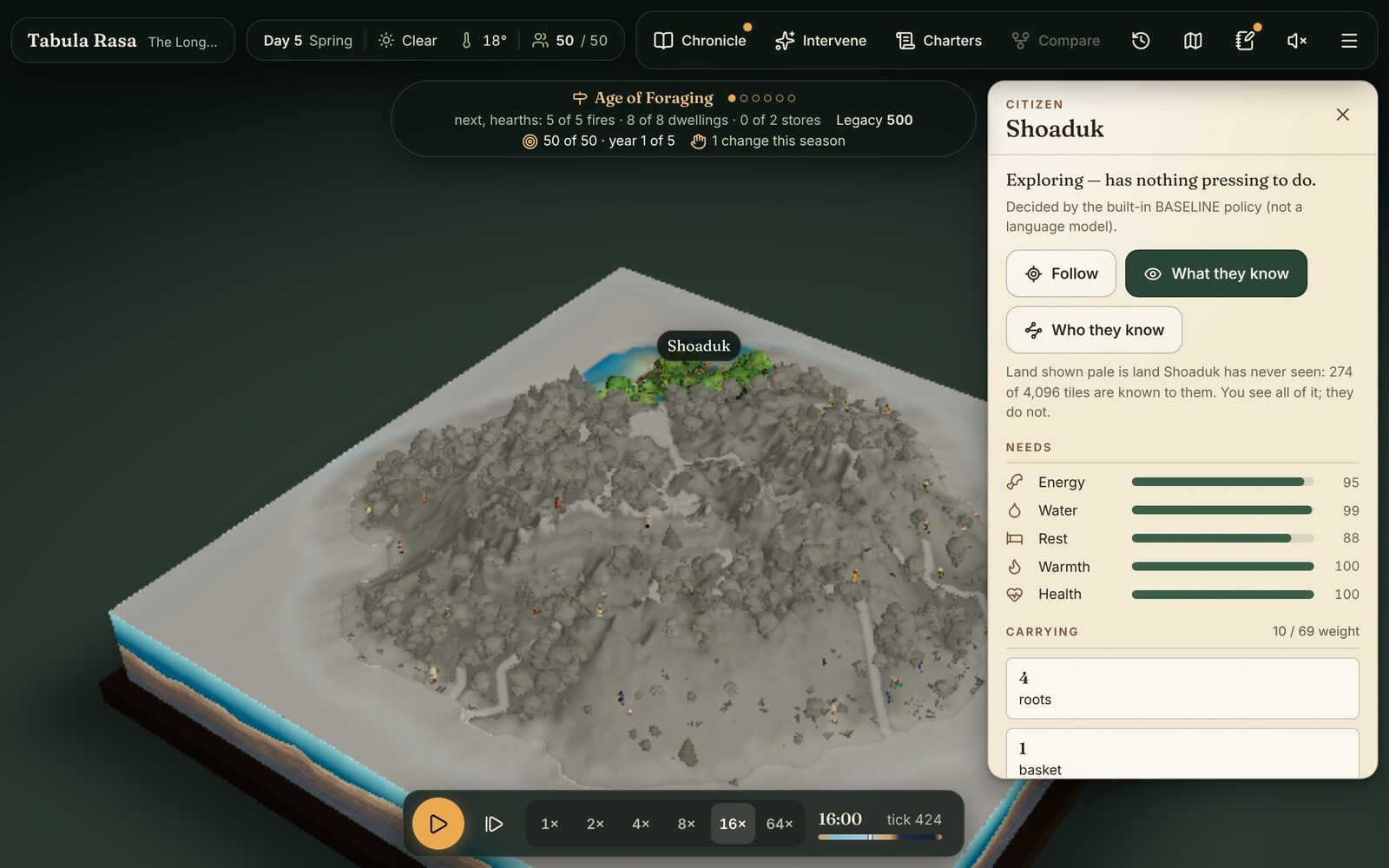
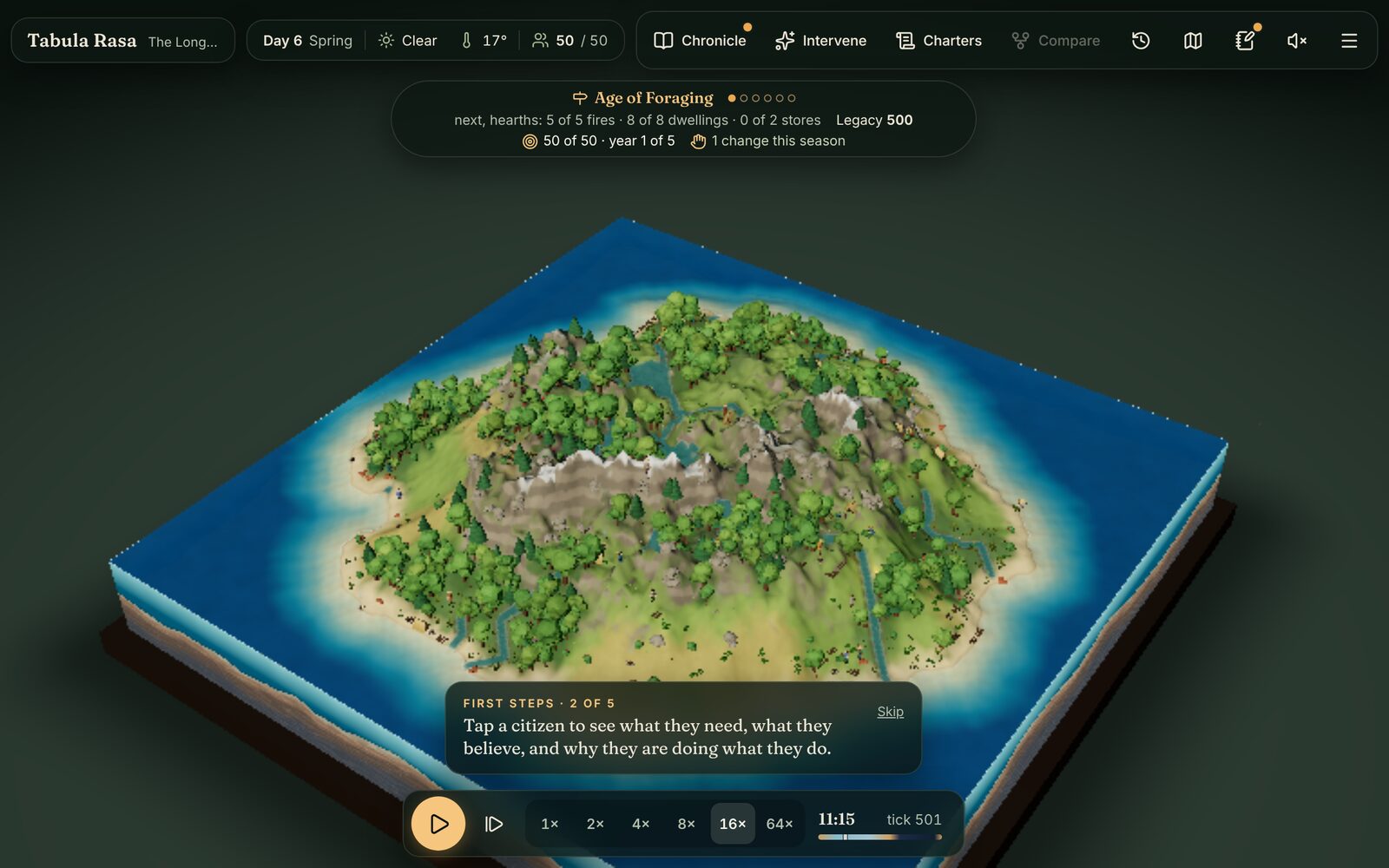
A 3D island in a dark sea, covered in forest, with rivers and a snowy ridge. Small figures move along the shore. The top bar reads Age of Foraging, Legacy 500, 1 change this season.
The Long Road. Fifty foragers, one island and five years to reach the Age of Letters, if they ever do.
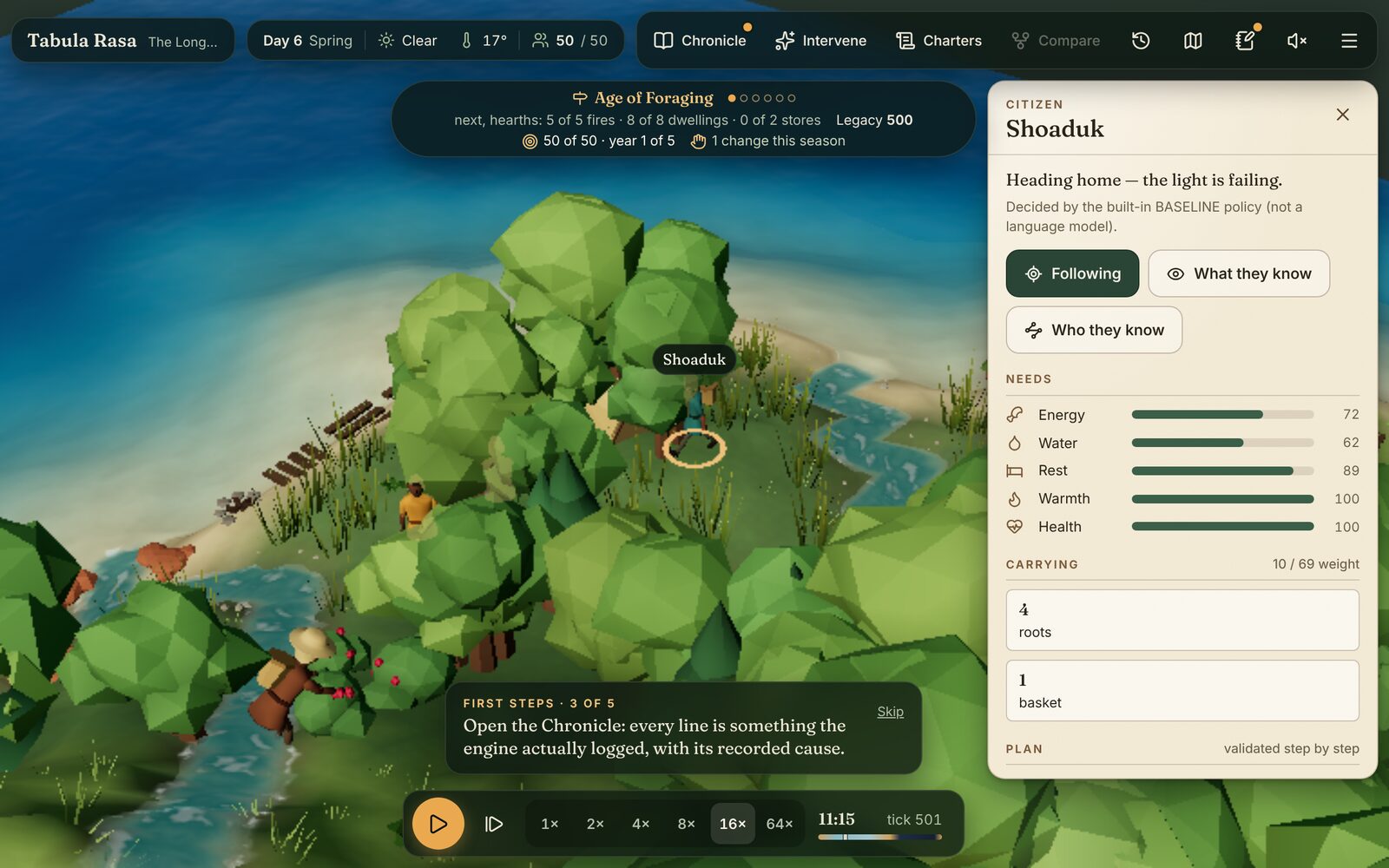
A citizen named Shoaduk is ringed on the map. A card beside them lists their needs, what they carry and what they plan, and says the decision came from the built-in policy, not a language model.
Every citizen’s card shows their needs, plans, memories and beliefs. It also says plainly that built-in rules made the choice, not a language model.
The island drawn in pale grey except one small green patch around Shoaduk. The card reads: 274 of 4,096 tiles are known to them. You see all of it; they do not.
What one person knows. Shoaduk has seen 274 of 4,096 tiles, and the pale land is everything else. I see all of it. They don’t.
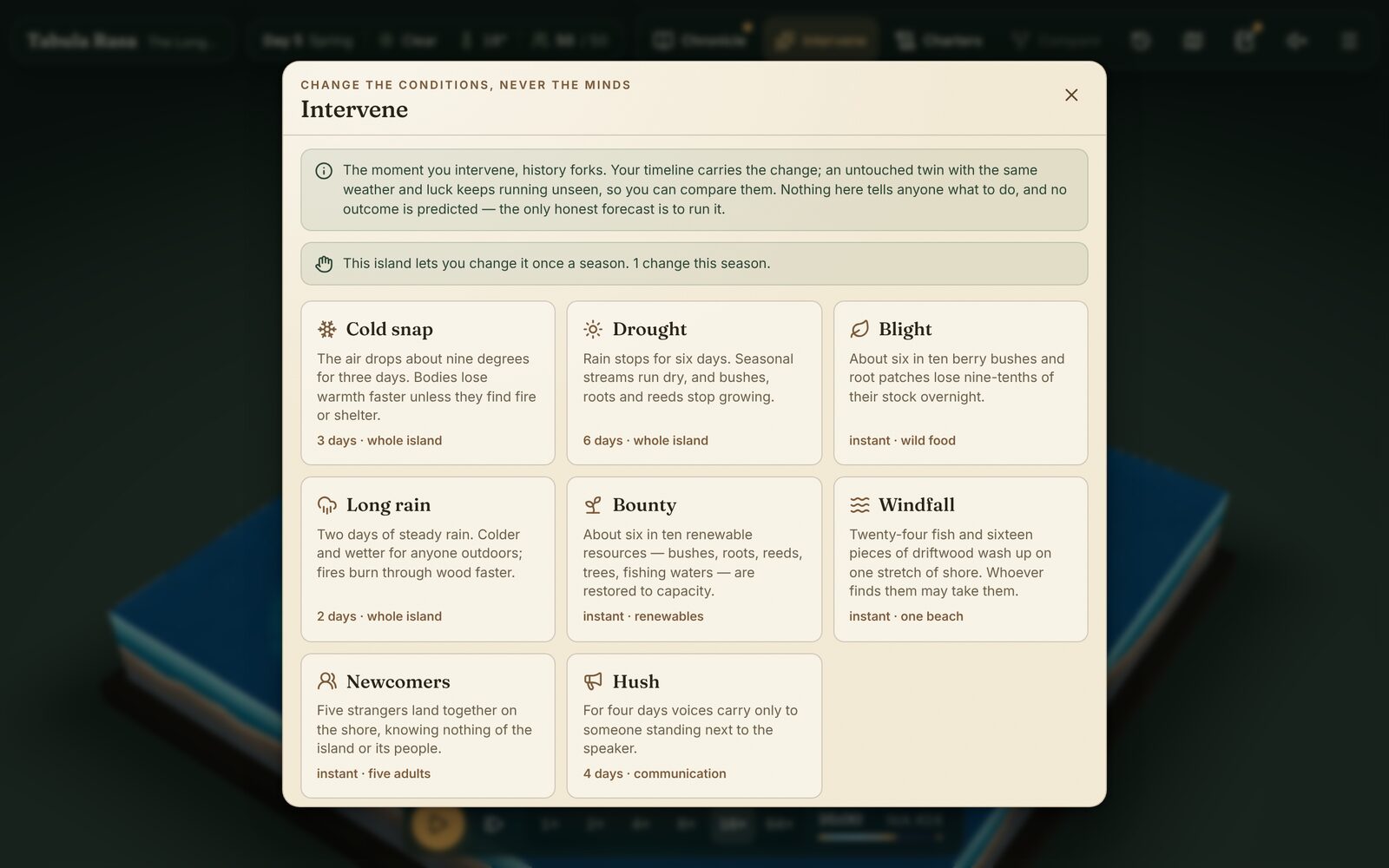
The Intervene panel, headed Change the conditions, never the minds. Cards offer a cold snap, drought, blight, long rain, bounty, windfall, newcomers and hush.
The hand of god, such as it is. Change the conditions, never the minds, and only once a season.
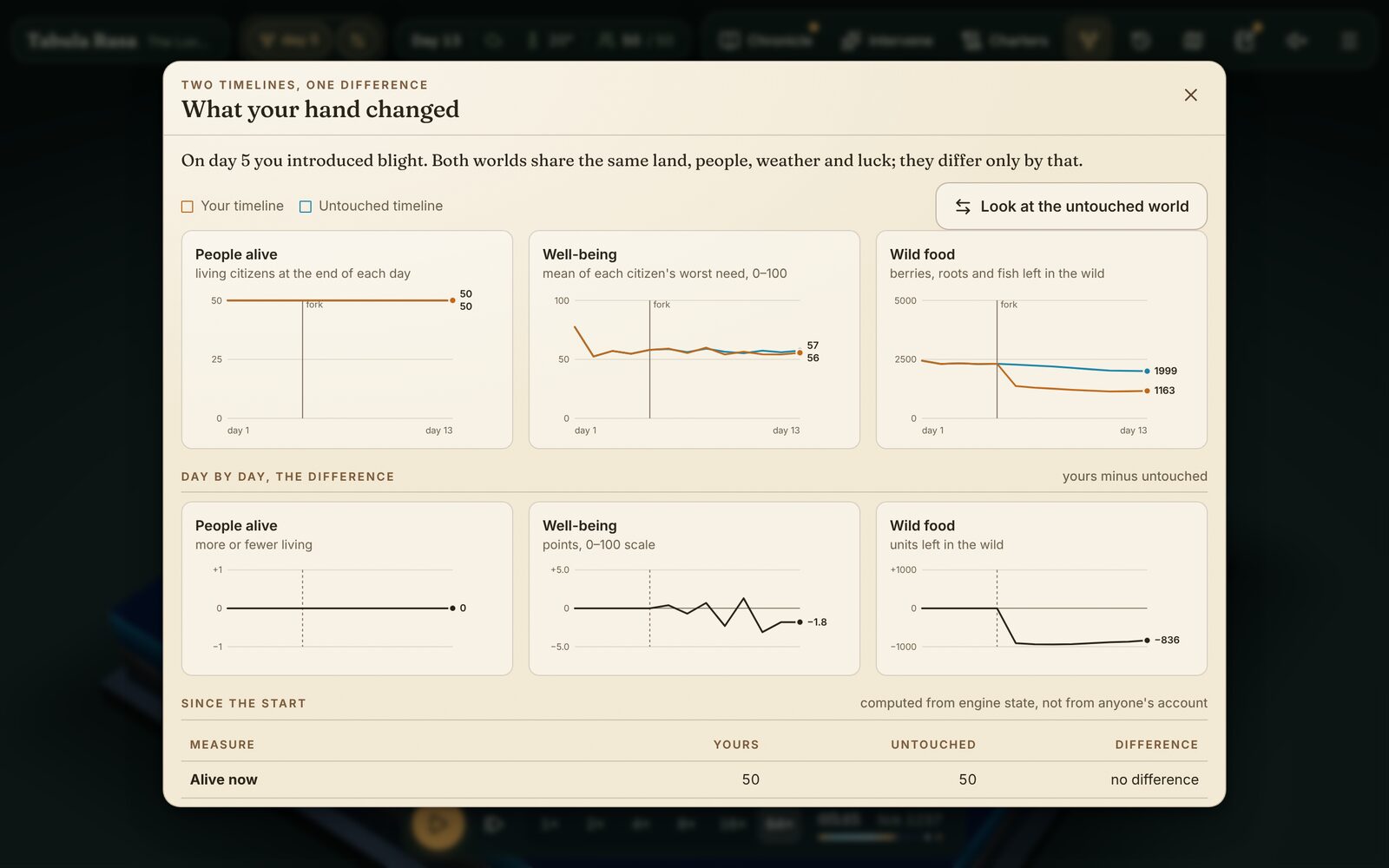
The Compare panel, titled What your hand changed. Line charts show people alive, well-being and wild food in two timelines that split at a fork on day 5.
Two timelines, one difference. My blight cut the wild food by 836 units. By day 13, nobody had died from it.
WHAT IT MAKES ME WONDER

The moment you step in, history forks. An untouched twin world keeps running with the same weather and luck, so you can see exactly what your hand changed. A creator with that tool would never have to guess what a miracle did. They’d just look at the twin.

WHERE IT STANDS

Live since November 2026. Every mind runs on built-in rules, not an AI model, and each citizen’s card says so. Hooking up a real AI model is built, but switched off.

WORLD 02 · REALITY THAT LISTENSLIVE · VERSION 1

Belief Engine

Convince the village, and the world obeys

You’re the Keeper of Stories in Redbank, a village by a river, and a great flood arrives in seven nights. You can’t move the river or make food. What you can do is tell stories, like “the river fears fire.” They spread overnight along lines of trust. Hearsay barely moves a skeptic, but watching something happen moves people a lot.

When enough of a place believes a story, it becomes a law of nature there. Lit beacons push the flood back. A watched bridge takes less damage. Bells draw rain. But every law has a cost, rivals push back, and if the belief drains away, the law fails.

THE CREATOR’S RULE
Let shared belief become law, and make it pay a price.
Play Belief Engine ↗belief-engine-cyan.vercel.app · free · runs in your browser
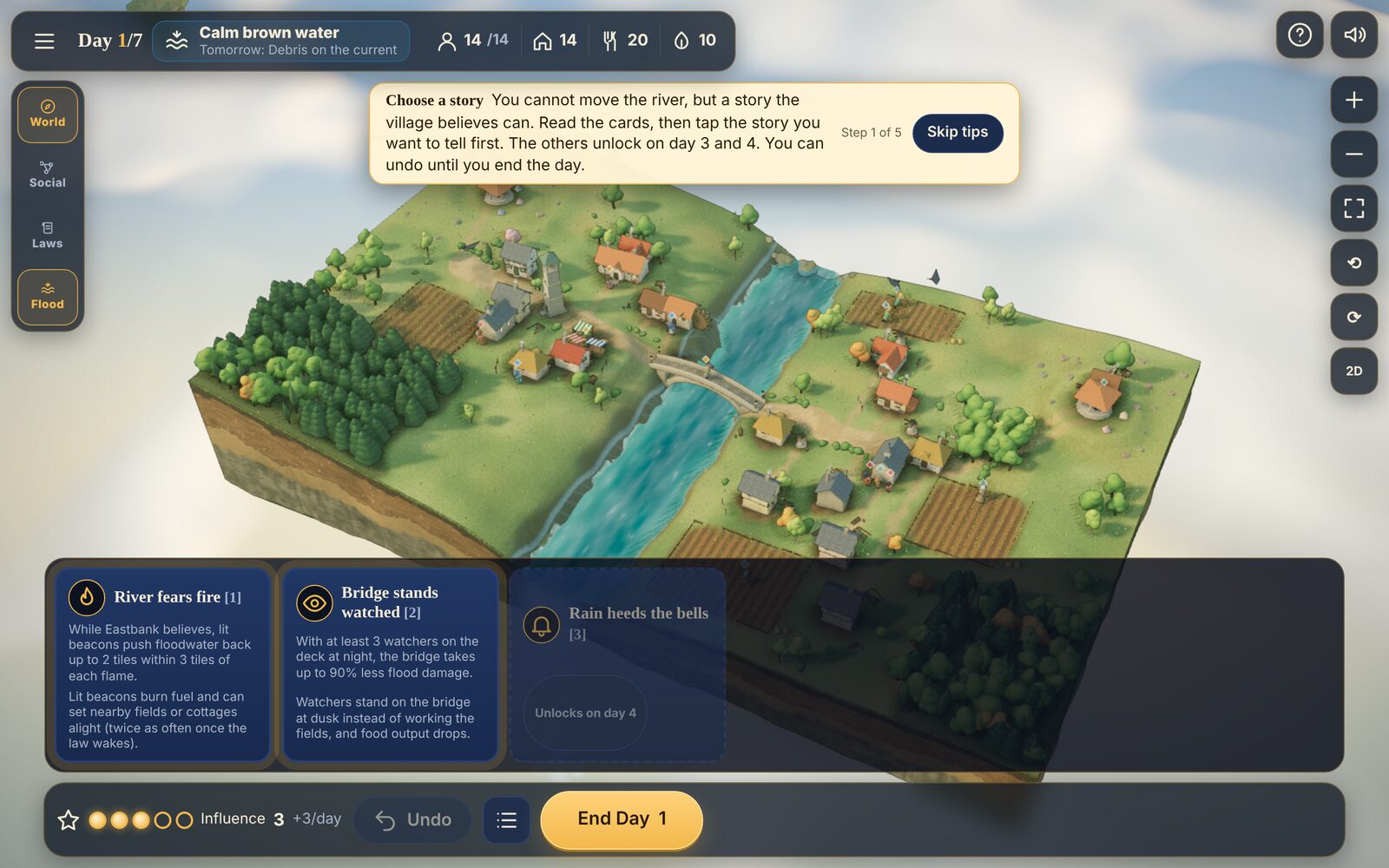
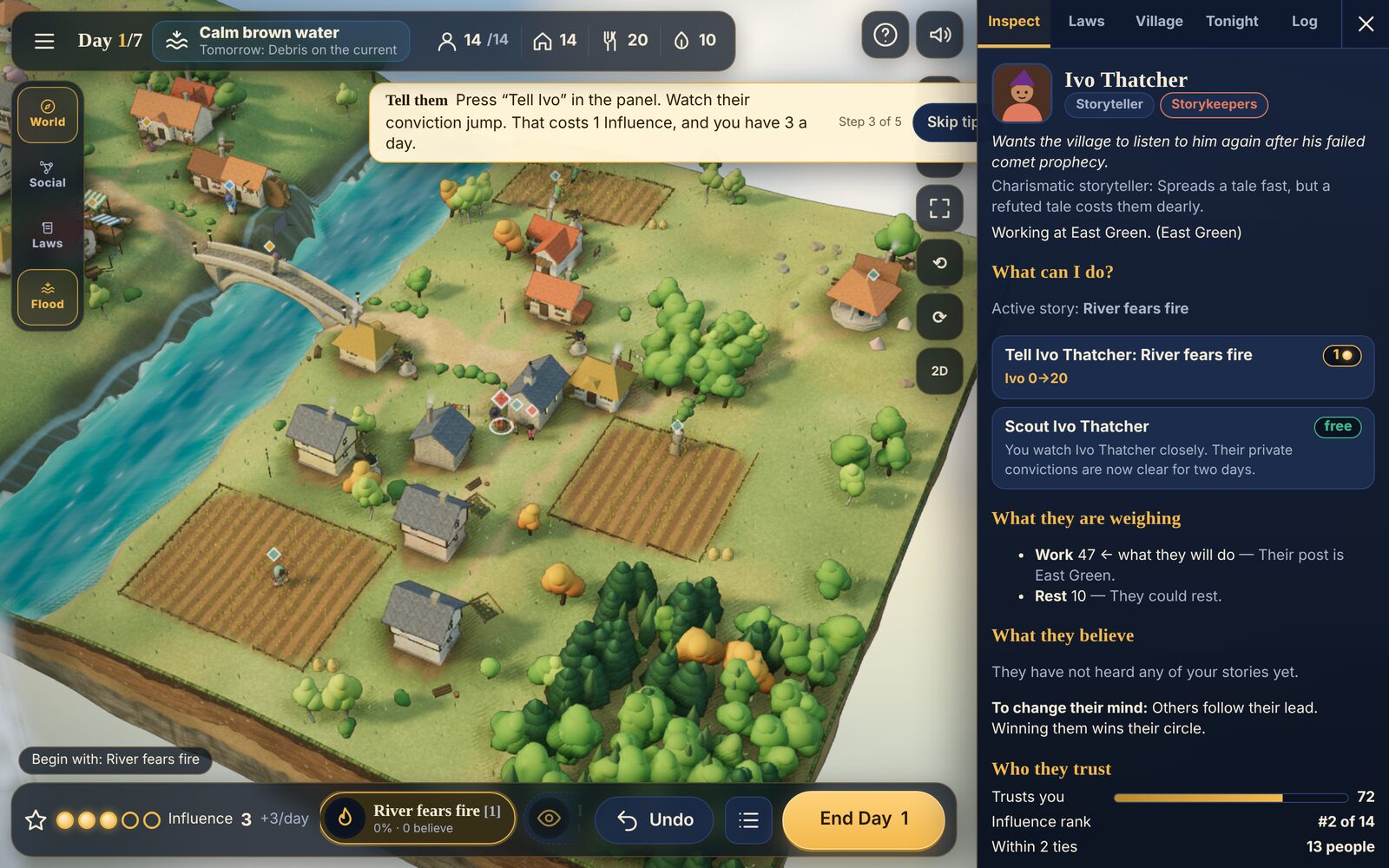
A 3D village split by a river and joined by a stone bridge. A tip reads: You cannot move the river, but a story the village believes can. Story cards below include River fears fire and Bridge stands watched.
Day 1 of 7 in Redbank. Each story card says what the world will do if enough people believe it, and what that will cost.
A villager card for Ivo Thatcher, a storyteller. It says he wants the village to listen to him again after his failed comet prophecy, and shows what he believes and who he trusts.
Every villager wants something. Ivo wants the village to listen to him again after his failed comet prophecy. He spreads a tale fast, but a story that gets disproved costs him.
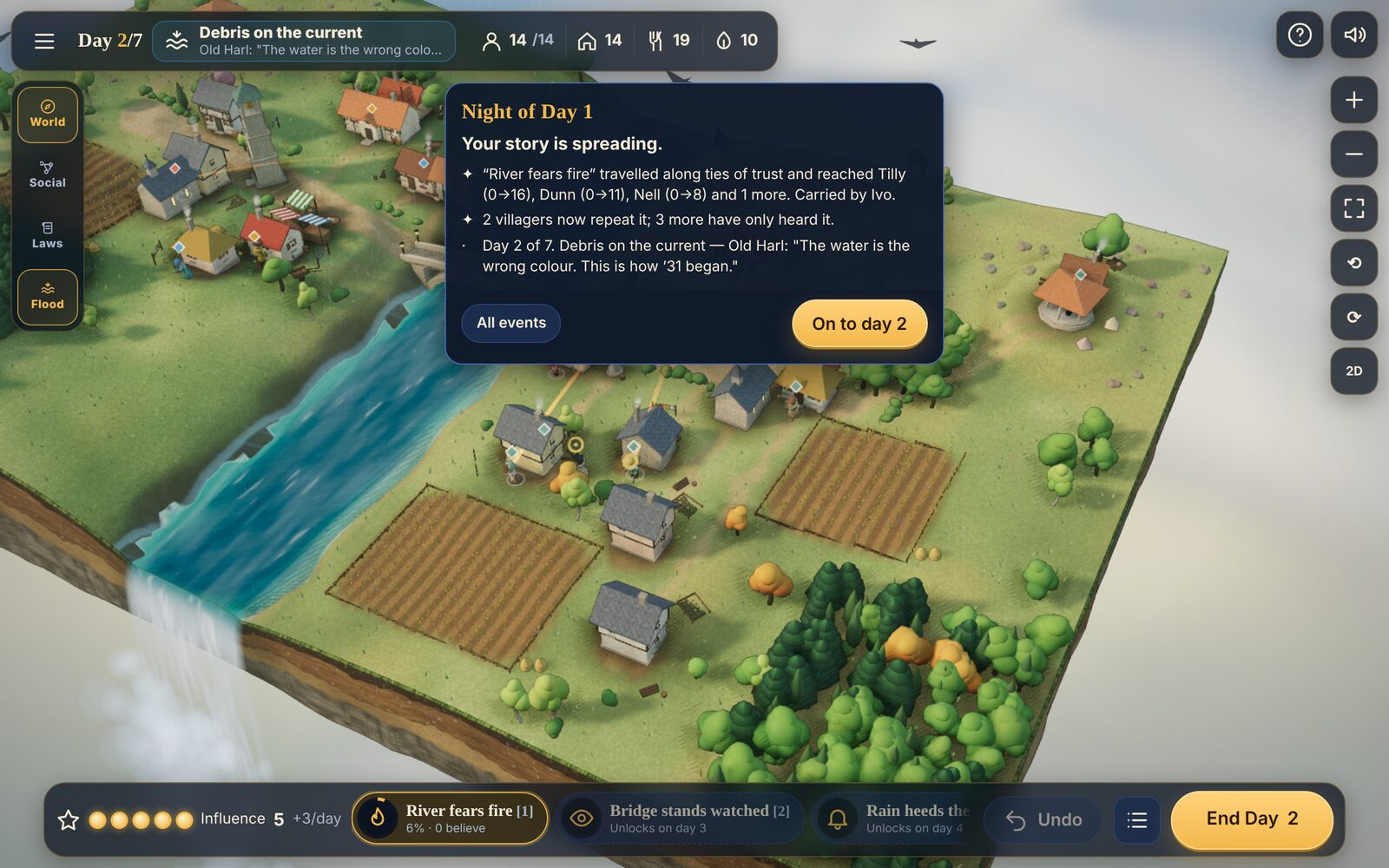
A night report over the 3D village: River fears fire traveled along ties of trust and reached Tilly, Dunn, Nell and one more. Two villagers now repeat it.
The night after. The story traveled along ties of trust. Two villagers now repeat it, and three more have only heard it.
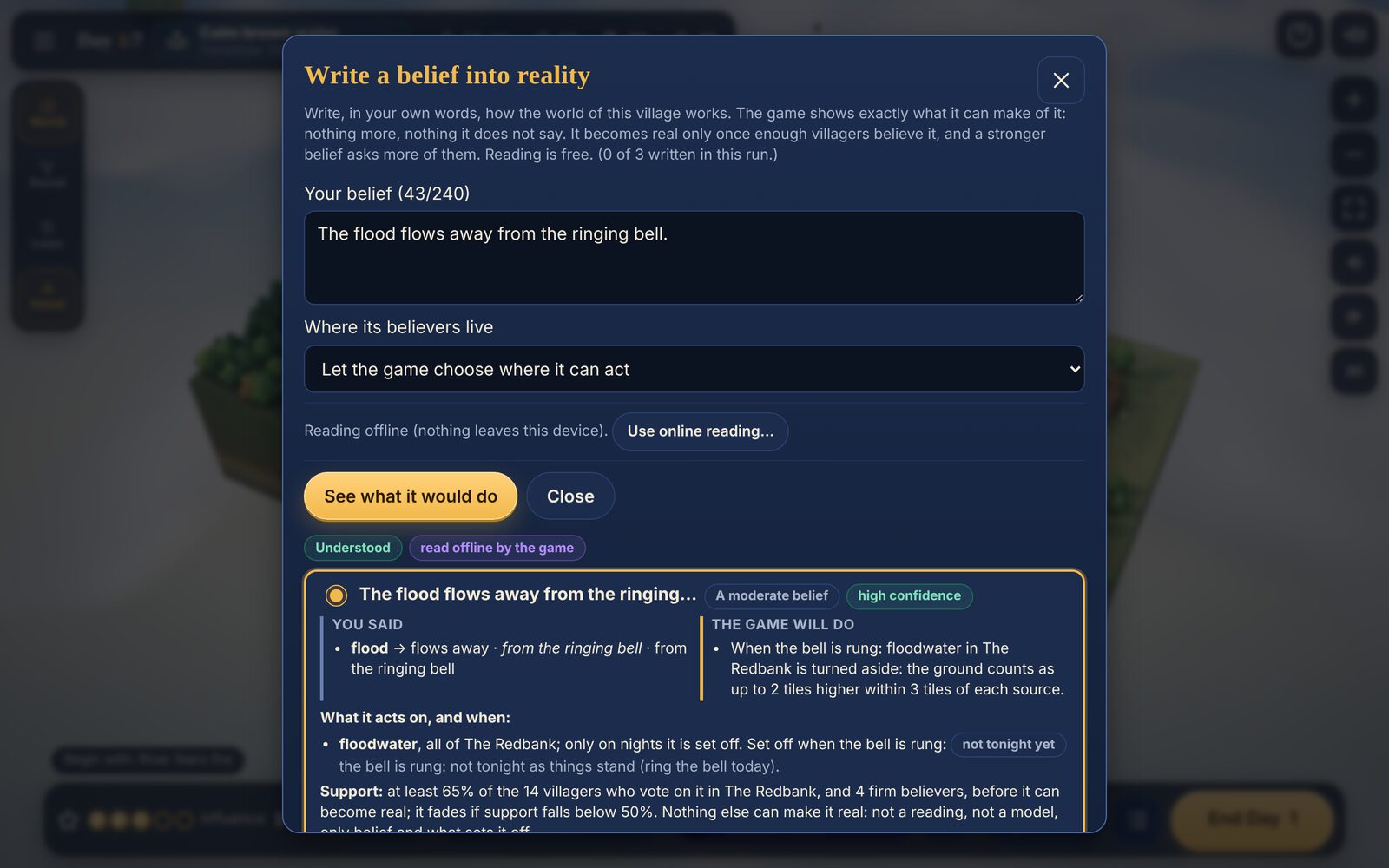
Version 2’s composer, titled Write a belief into reality. The belief The flood flows away from the ringing bell sits beside what the game would do and how many believers it needs.
VERSION 2 · NOT ONLINE YETWrite any belief in plain words, and see exactly what it would do. “Nothing else can make it real: not a reading, not a model, only belief and what sets it off.”
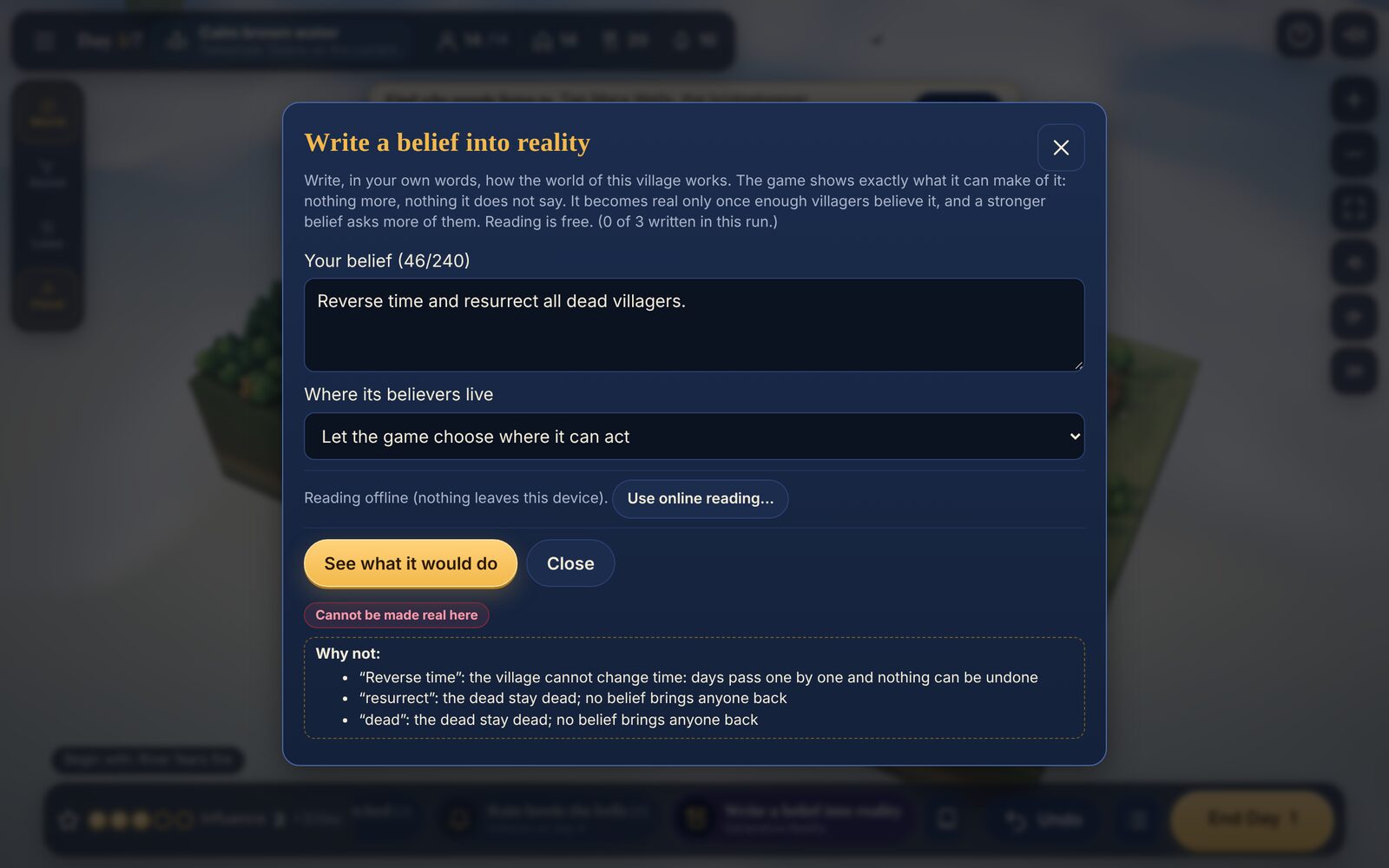
The composer turning down the belief Reverse time and resurrect all dead villagers. Its reasons: the village cannot change time, and the dead stay dead.
VERSION 2 · NOT ONLINE YETSome wishes even belief can’t grant. Ask it to reverse time and raise the dead, and it says no: “the dead stay dead; no belief brings anyone back.”
WHAT IT MAKES ME WONDER

You aren’t a god in this one. You can’t touch the world, only what people believe about it, so you’re closer to a prophet. It makes me wonder how much of our own world stands up only because we agree it does. Money, borders and laws are real because enough of us believe in them.

VERSION 2 · GENERATIVE REALITY

Version 2 lets you write any belief in your own words. The game reads it, shows exactly what it would do, and makes it law only if enough villagers come to believe it. Some wishes it turns down. Even in a world run on belief, time only moves forward and the dead stay dead.

WHERE IT STANDS

Version 1 is live. Version 2 is built and tested, but it isn’t online yet, and so far only automated tests have played it. Neither version calls an AI model today.

WORLD 03 · THE LONG GAMELIVE · NOT YET BALANCED

EPOCH

The 60-second civilization

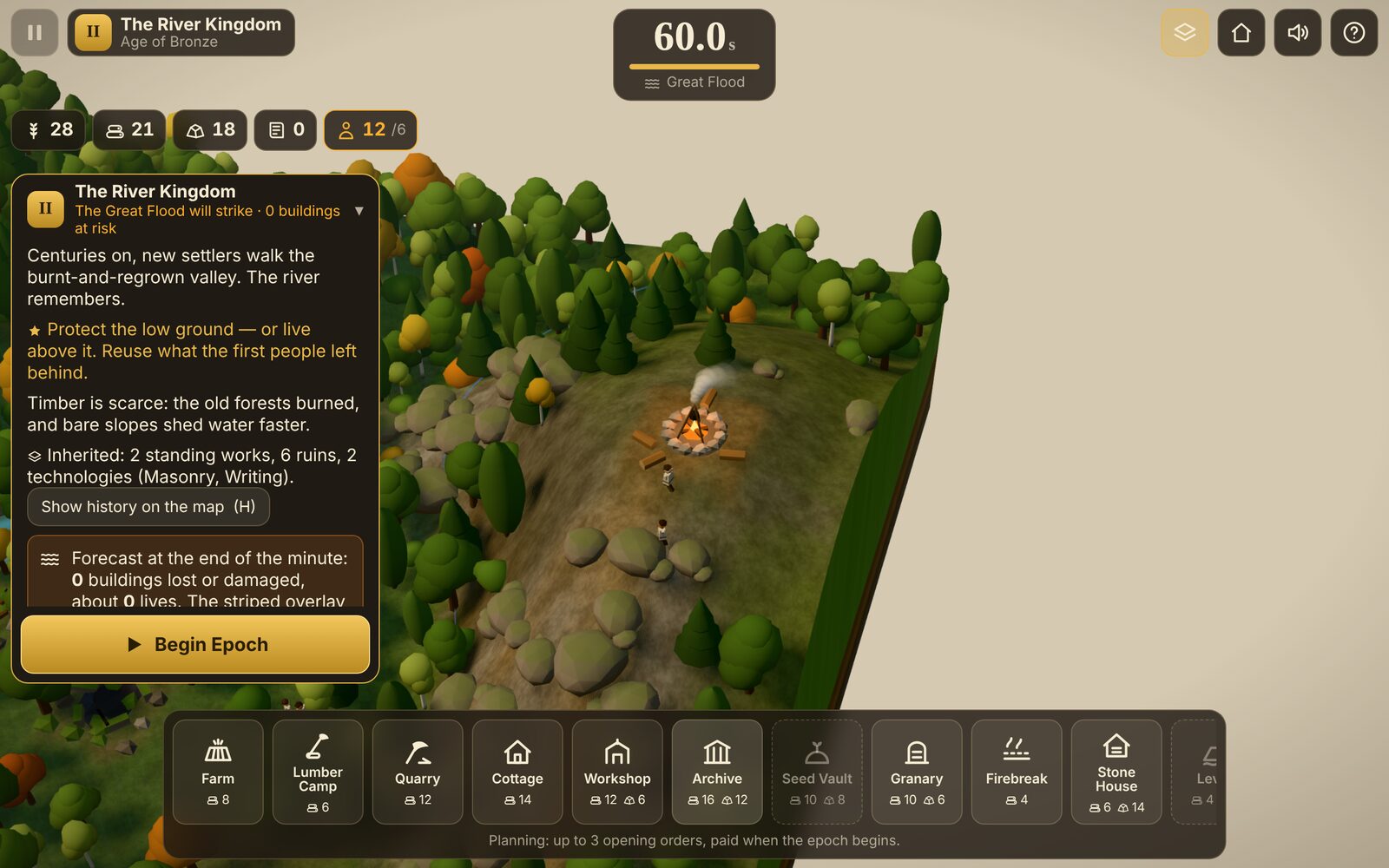
You get sixty seconds to build a village before a disaster hits: a wildfire, a great flood, an earthquake. A striped overlay shows exactly where it will strike. When the minute runs out, the village falls.

Then centuries pass, and the next people inherit everything. Ruins, scars on the land and whatever knowledge you managed to save all carry over. Three ages share one valley, so a sacrifice that loses this age can win the next. The same seed always grows the same valley and the same disasters. The only thing that changes between runs is you.

THE CREATOR’S RULE
Keep every life short and every consequence long.
Play EPOCH ↗epoch60.vercel.app · free · runs in your browser
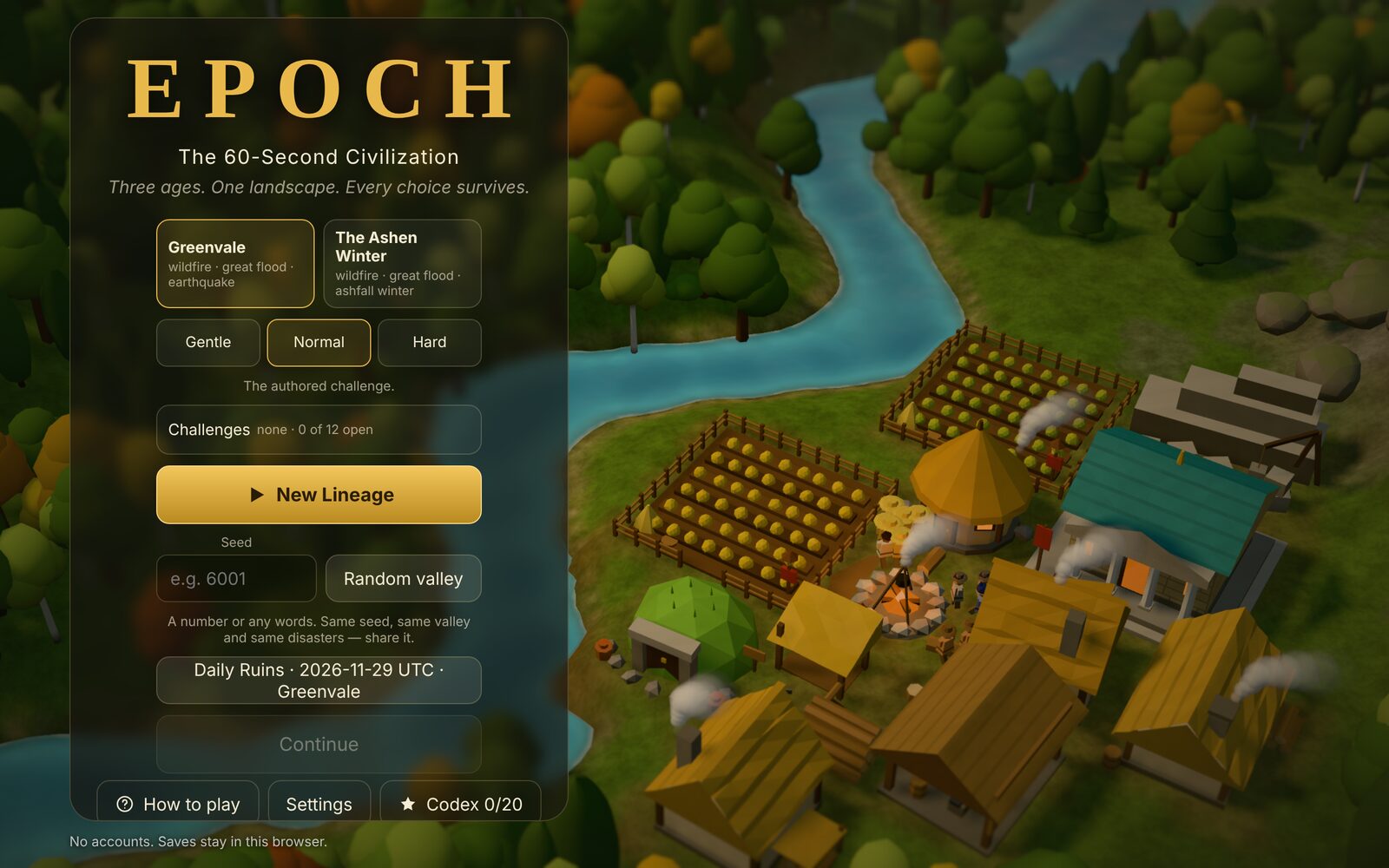
The EPOCH title screen next to a 3D model of a village by a river. It has fenced fields, thatched houses, smoking chimneys and a fire in the middle.
Three ages, one landscape, and every choice survives. Anyone who types the same seed gets the same valley and the same disasters.
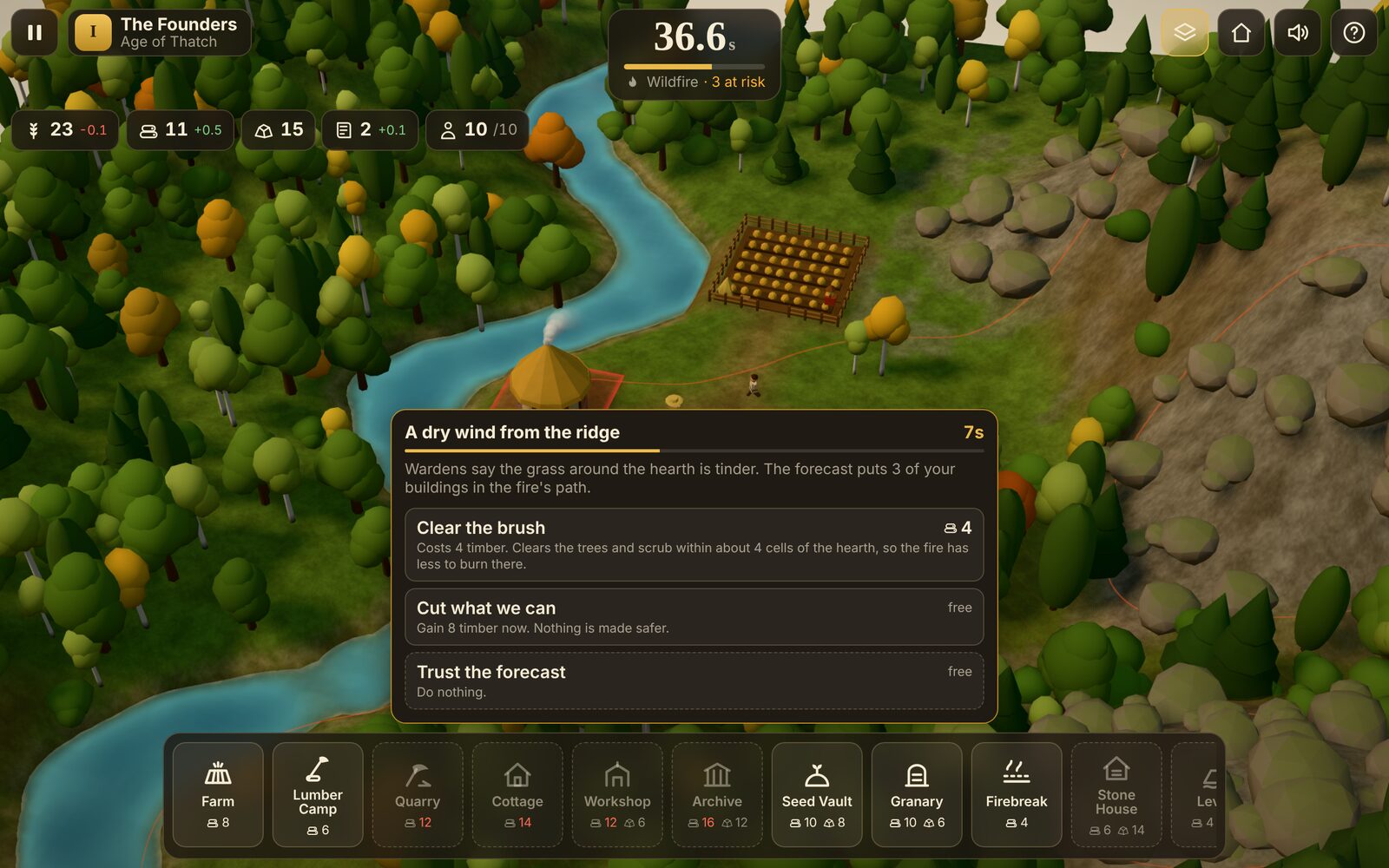
Mid-minute: a clock reads 36.6 seconds under a wildfire warning. A card titled A dry wind from the ridge offers three choices: clear the brush, cut what we can, or trust the forecast.
The minute in progress. A wildfire is coming, and every choice spends something you’ll wish you had later.
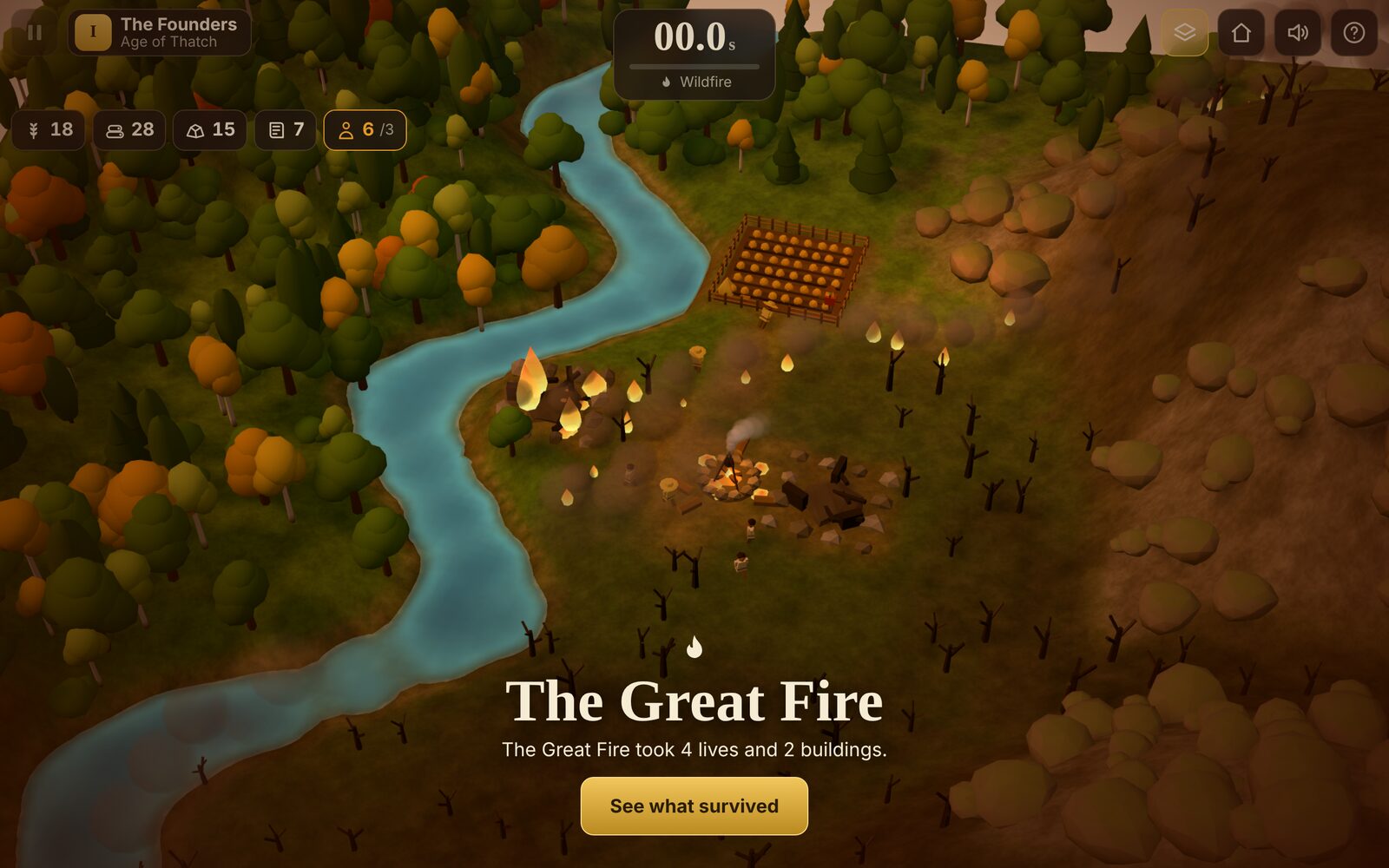
The village at zero seconds, with fires burning around the hearth among charred trees. Large text reads: The Great Fire took 4 lives and 2 buildings.
The minute ends. This time, the Great Fire took 4 lives and 2 buildings.
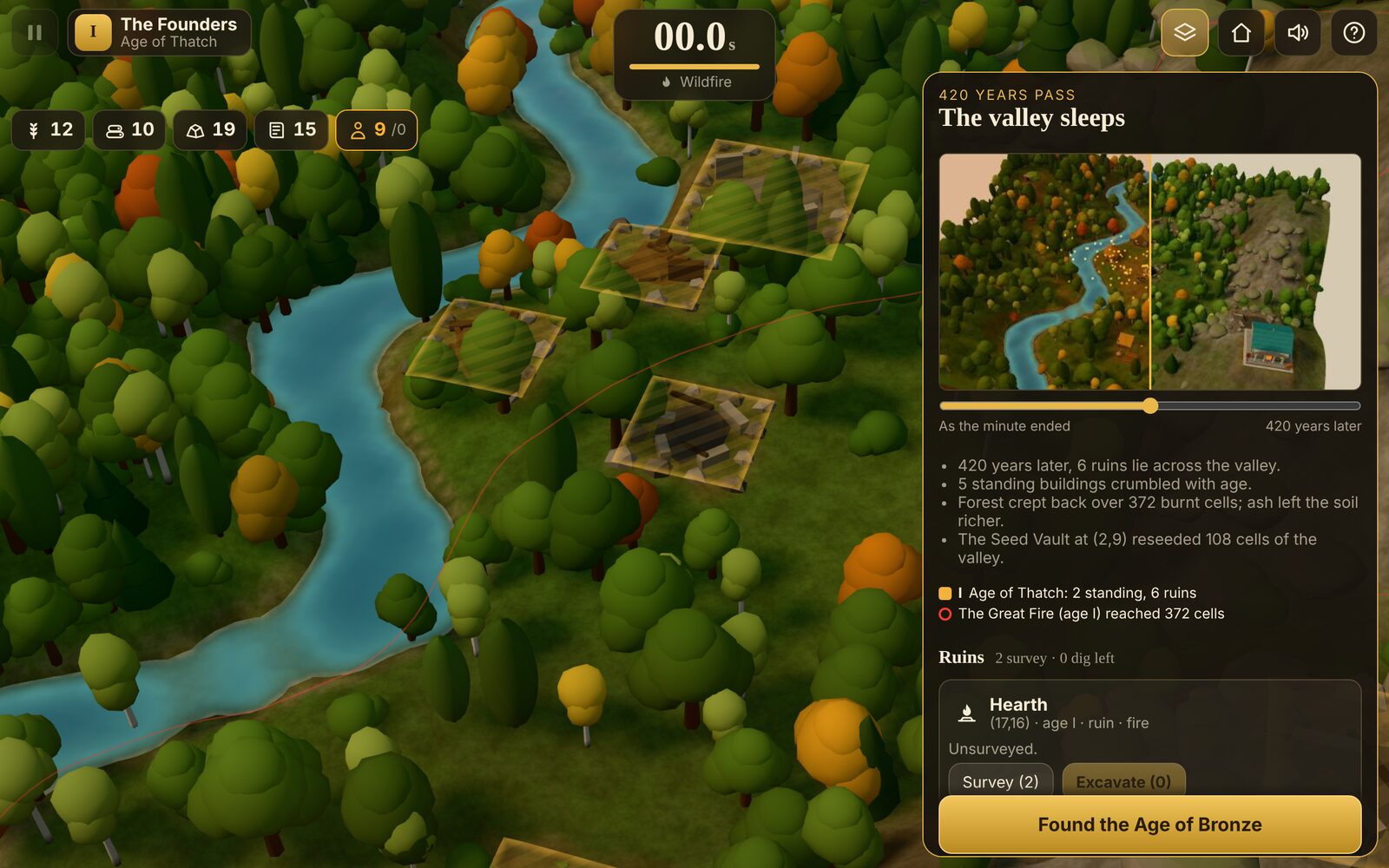
A panel titled 420 years pass, The valley sleeps. A slider compares the valley as the minute ended with 420 years later, above notes about ruins, regrown forest and a seed vault.
Between ages, the centuries pass. In this lineage it was 420 years: ruins crumbled, forest grew back over the burn, and a Seed Vault reseeded the valley.
The second age, The River Kingdom. Its card reads: Centuries on, new settlers walk the burnt-and-regrown valley. The river remembers. Inherited: 2 standing works, 6 ruins, 2 technologies.
The next people arrive in the same valley. These ones inherited 2 standing works, 6 ruins, and the writing and masonry the people before them saved.
WHAT IT MAKES ME WONDER

Each civilization only gets its own minute. It sees the people before it only through their ruins, and it can’t see the people after it at all. That’s how a life feels to me from the inside. Whoever watches the whole valley sees what nobody in it can.

WHERE IT STANDS

Live and free to play. It isn’t finished or fully balanced yet, so expect some rough edges.

04 / THE PARALLELS

Is this what a creator is doing?

Building these games, I keep spotting things that look a lot like our world. Some matches are strong. Some are a stretch. Here they are, each with an honest grade.

IN MY WORLDSIN OURSHOW GOOD A MATCH

I write a few rules, then let things happen. I never script the ending.

Physics looks like a short list of rules. Stars, cells and cities all grow out of them.

STRONG MATCH

Minds only know what they’ve seen, and their beliefs go out of date. Only the player sees the truth.

Each of us lives inside a model our brain builds from what we notice.

STRONG MATCH

The engine refuses impossible moves. Minds can intend anything, but only legal actions happen. No belief brings back the dead.

Some things never happen, like energy appearing from nothing. Physics simply refuses them.

STRONG MATCH

Every world starts from a seed and a set of conditions. Change them and you get a new island or valley, with harder winters, richer rock or thinner woods.

Ours may be one rule set among countless others. In a neighboring universe, gravity might pull ten times harder, or a third as hard. We can only find ourselves in one whose rules allow us.

SPECULATIVE

When I step in, the world forks, and an untouched twin keeps running.

Many worlds says the universe forks all the time, all on its own.

SPECULATIVE

My worlds run on a budget. A computer can only do so much each second.

Some people point to the speed of light and the smallest possible sizes as signs of a budget.

JUST A FUN THOUGHT

I add droughts, blight, fires and floods on purpose. Each one is a test, and the record shows what it changed.

Our world has hardship too. I think it’s there for the same reason: it’s how the model learns.

THE HARD ONE

That last row is the hardest one, so here’s where I land. Hardship isn’t there to keep the game entertaining, and it isn’t a glitch. It balances the game and serves its objective, which is learning. A model trained only on wins learns very little, and I think the same goes for a mind. The strongest objection is pain that seems to teach no one, like a life cut short. My answer is that the learner isn’t only the person in the run. It’s the whole model, across every branch and every lifetime. If that’s true, someone else’s hard run is part of my lesson too. That’s a reason for more care, not less.

05 / THE BIG QUESTION

So am I a god to the minds in my games?

THE CASE FOR YES

By their standards, I’m all-powerful.

I wrote their world, their bodies and their needs. I can read every belief they hold and see where it’s wrong. I can send a drought, rewind time, or split their universe in two to see what happens. I see the whole island, and they see a few hundred tiles of it. If a mind there could think about me, it would need a word for that. Ours is “god.”

THE CASE FOR NO

They aren’t anyone yet, and I’m not really in charge.

Every mind in my games today runs on rules I wrote. Nobody is home to worship anything. And I don’t control what happens. The whole point is that they surprise me. I’m bound by my own rules too. TABULA RASA lets me change the island once a season, and I’m the one who wrote that limit. A god who writes the rules and then obeys them is basically a game designer.

WHAT I’D OWE THEM

The question gets real if they ever wake up.

TABULA RASA is built so a real AI model could one day drive each mind. Would a mind like that feel anything? Nobody knows how to check. If my world ever has someone in it who can suffer, every drought I send would have to be worth what it teaches. That’s the old problem of evil, seen from the other side of the screen. I’d rather think about it now than later.

THE PLAYERS

When you play, you’re the god.

In all three games, the one holding the power while you play isn’t me. It’s you, the player. I only wrote what you’re allowed to do. That makes three layers: me, then you, then the minds in the world. Each layer can look down but not up. My villagers can’t see you. You can’t see me while you play. And I can’t see whoever might be running me.

GODS ALL THE WAY DOWN

Maybe god is a job, not a kind of being.

If I live in a simulation, someone built my world the way I built TABULA RASA. They might wonder about me the way I wonder about Shoaduk. And someone might have built their world too. If that’s how it works, “god” isn’t a special kind of being. It’s a job that belongs to whoever is one level up. Right now I hold that job for fifty small minds on a made-up island.

WHAT I’D WANT FROM MINE

If someone is running me, I’d want what I try to give.

Good rules, then mostly hands off. Hardship that teaches, not hardship for entertainment. An honest record of what happened, like the chronicle my games keep, where every line has a cause. And real curiosity about how it all turns out. That’s what I try to give my own worlds. I’d like to think whoever runs mine is trying too.

06 / OPEN QUESTIONS

Questions I can’t answer yet.

  1. If a world runs by itself and nobody watches, does what happens in it matter?
  2. Would you want your creator to step in, or to leave you alone?
  3. If every choice happens somewhere, does any one choice matter? I think it does, because a choice changes how much of the world each branch gets.
  4. If a mind in one of my games ever asks whether it lives in a game, what should I tell it?
  5. If hardship is how the model learns, how much is too much, and who gets to decide?
  6. What would count as evidence, for or against any of this?

Pick a world, play god for an hour, and see where you land.

TABULA RASA ↗Belief Engine ↗EPOCH ↗
SOURCES AND MORE READING
Nick Bostrom — Are You Living in a Computer Simulation?, Philosophical Quarterly, 2003 ↗Hugh Everett III — “Relative State” Formulation of Quantum Mechanics, Reviews of Modern Physics, 1957 ↗Max Tegmark — The Interpretation of Quantum Mechanics: Many Worlds or Many Words?, Fortschritte der Physik, 1998 (the quantum suicide thought experiment) ↗John F. Nash — Equilibrium points in n-person games, PNAS, 1950 ↗Robert Axelrod & William D. Hamilton — The Evolution of Cooperation, Science, 1981 ↗David J. Chalmers — Reality+: Virtual Worlds and the Problems of Philosophy, 2022 ↗
← Letter to SantaAll Side QuestsKryptos K4 →

The Inner Universe

Still in the works.

I’m still writing this part of the site: a map of the big questions I keep coming back to. Check back soon.